
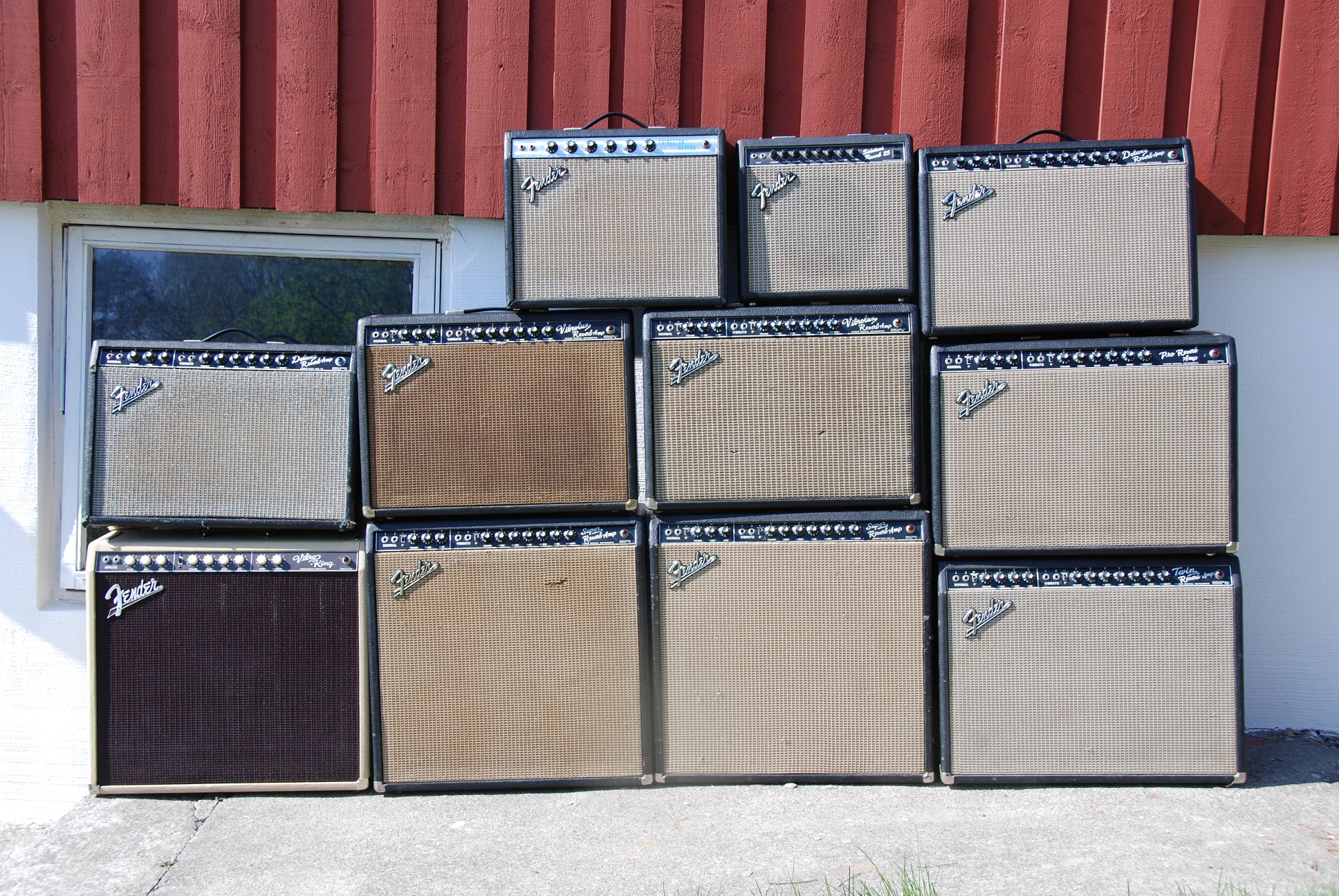
How to select amp?
Our amp section contains information about blackface and silverface Fender models produced between 1963 and the late 70′s. We like the other Fender amps too, but in our opinion the blackface and silverface amp are the most versatile, robust, simple, best sounding and most value for the money-amps of all Fender amp eras. They are simple and basic point-to-point wired amps with built-in reverb and tremolo.
Picking the right tool for the job
We will share a story about drummers and guitar amps. We play many gigs with smaller amps such as Princeton Reverbs or Deluxe Reverbs, and most times we enjoy cranking these low wattage amps. Our usual drummer is a careful and steady drummer who does not play awfully loud like some punk rock drummers. Our drummer keeps the stage volume low and we love him for that. At one gig at a corporate party in a 150 seat club, a friend of the band stepped in for our drummer for a couple of songs, starting with Jimi’s version of All along the watchtower. Our friend drummer happens to be twice as loud and we couldn’t practically hear anything on stage except mr. “Mitch Mitchell” furiously banging his snare and crash. The Princeton Reverb amp was already set at volume 6 with no more headroom left and could not go further without delivering too much distottion. On the stage the band had a terribly bad tone experience, and who knows how the music sounded out the PA. The poor Princeton Reverb even had an upgrade 10″ speaker but still couldn’t cut through the mix. The whole day after we regretted not bringing a bigger amp, either a Vibrolux or Pro Reverb. Or perhaps a 1×12″ or 1×15″ extension cabinet We are the kind of people who like to feel the guitar in our pant legs. We want hear the beautiful soul from our closely selected bouteeqe speakers and not from the monitors. We doubt that a Deluxe Reverb would have been powerful enough unless it had 6L6 and a loud speaker. Not even a hot rod version of the Princeton Reverb with all the mods (Deluxe OT, 12″ speaker, Stokes, Paul C, diode rectifier) would have stood up against such a drummer and gotten away in an elegant manner. What you need is pure, clean headroom and speaker areal. This is where extension cabinets come in handy offering a better stage monitoring.
What do the Fender blackface and silverface amps sound like? Listen for yourself. Here are a few of them:
One amp to rule them all
We need our stuff to perform and adapt to varying environments for practice and gigs, outdoor, indoor, alone or in a band. Any tube amp player should be aware of the importance of dialing in the sweet spot to achieve sustaining harmonics, tube distortion, rectifier sag and transformer sag, aka. the tube amp mojo & magic. So how do you achieve all this with your specific amp not beeing too loud, too low, too muddy, too clean or too brittle? Wouldn’t it be nice to bring your favorite amp at most gigs and have the knowledge to tweak it before each gig?
Mod trends
It’s a constant in our universe – as long as man possess gear, man will mod gear. It’s like GAS. You just gotta have that amp or that guitar. Even if you already own plenty. New peace of gear rarely brings anything new to the table. Man will never stop coming up with ideas and rationale for why he constantly needs to aquire more gear. Man convinces himself, the wife and all who stands in between the gear and himself – the only responsible thing to do now, is to go get that gear. Man needs, man deserves. So, why constantly seeking for changes? A no-brainer! You want something else, either less, more or differently out of your amp and you don’t want to buy another amp. For many players it’s more affordable to mod than to buy something else. Your amp may have a sentimental history and and a character that you already like and that you might not get in another amp. But if your amp is a mint vintage peace of gear with high collector value, be careful and think through what you do. Modding collector amps will most likely ruin the amp’s value – in this case it’s more affordable to sell it and rather get the a player’s amp.
You may get asked – why mod a classical tube amp to be some other wanna-be amp? Why not just get another original amp with the characteristics you desire? Because, most likely, one amp already exists that is closer to what you want. You might get told, by the great and the wise, that by modding you don’t understand nor appreciate the intention behind the original amp design.
What we believe, by own experience and after talking to and reading several other player’s confessions – man often perform mods to prove to himself he is actually able to perform mods. Man wants to confirm to himself he can alter the tone of classic tube amps. This means more to man than to get closer to the actual tone he seeks and that has been ringing inside man’s head for some time. If an amp is low-wattage and breaks up comfortable at low volume, then man will mod to increase headroom. A big amp with lots of clean headroom? Be sure man will mod to reduce that big headroom and make the amp suitable at lower stage volumes. Clean amps will be hot-rodded, crunchy and sweet amps will be cleaned and tightened up.
We find that some amps have more rationale for mods than others. A general trend among players is to lower the clean headroom in large amps to get earlier break up and sweet tube distortion at lower volumes. Smaller amps are tuned to increase the clean headroom allowing players to bring reasonably sized amps to small/medium gigs. You’ll recognize these trends reading about the amps on the web.
After performing mods and trying them out for a while, you may find yourself reversing some mods, maybe even put the amp together to complete original spec. Was it worth it? Hell yeah. A good thing about modding is that you get to learn how amps work and are put together. You learn what it takes to tweak tone. Maybe more important – you learn what your own preferences are after having checked out a million different kinds of mods and resulting tones. You also experience that the tone you are seeking is a moving target. It changes as you develop new styles and preferences, as you get inspired by newly discovered guitar players, as man grows as a human being.
We have a special interest in mods that satisfy one or more of the following criterias:
- can be enabled in just a few minutes
- easy reversible without ruining the value of the amp
- does not significantly change the key characteristics of the amp
- makes the amp more versatile and able to cover more ground than in original state
Like this site? Help support it by donating to the developer and become a contributing member of fenderguru.com.
A bit late to the vintage game after some mistakes into hedonism;
I just did the V1 pull and PI switch to 12AX7 and my Master Volume Pro Reverb (w/ JBL’s) no longer needs to be blackfaced! At least not yet…
Thank You! God Bless, TM
I also have a 1965 BF Tremolux which I am now wondering what it would respond to pulling V1 preamp tube. I wouls imagine it is also the NORMAL channel preamp, as it is the AB763 circuit…just no reverb and only 4 pre-amp tubes total. Disappointed there is no section for Tremolux’s on the site! Though relative rarity may explain…they seem to be a great value these days for true AB763. No reverb is tough, reverb pedals are getting better though. How about the Phase Inverter switch 12ax7…last preamp tube v4?
Yes, the blackface Tremolux with AB763 circuitry has a similar tube layout as i.e. Deluxe, just with 6L6GC in stead of 6V6. The same tube mods can be done.
V1 – 12AX7 Normal channel preamp
V2 – 12AX7 Vibrato Channel preamp
V3 – 12AX7 Tremolo
V4 – 12AT7 Phase inverter
V5 – 6L6GC Power amp
V6 – 6L6GC Power amp
V7 – GZ34 Rectifier tube
Much obliged for the list and reminder of Deluxe similarity. I thought I read here that the pulling of V1 works because it pushes the 2nd gain stage more…which the Tremolux does not have? Or is the V3 or V4 split up for 1/2 use as an additional gain stage?
Fabulous site btw, I have started playing Texas Blues style today…innstead of the jammy/Garcia type style I have been phasing thru. So if you want to promote the genre it is working! Of course Duane Allman and Stevie were my original inspiration for playing
Well I see you clearly explain no extra gain stage…I haven’t A/B yet so I cant be sure the Trem’ sounds different yet. I also had the two channels jumped together before so..
I do have an issue with the Tremolo I may as well run by you:
It only functions when the Intensity pot is at 9 or above. I am too novice to know if it has been modded, or is just a bad tube or cap. Recent purchase. Thinking about the Trem/pre-amp gain mod. and wondered if it already has something done? Sound familiar to you?
Great to hear about your playing. The raw and unfiltered texas blues style has also inspired us a lot, both tonewise and in terms of playing styles. The first TBirds concerts with Kid Ramos and Preston Hubbard in 1996 and 1998 are still one of my strongest musical memories. I then knew for sure I wanted to play that kind of music.
You are right that the trem disconnect mod will have less effect on amps without reverb and that extra gain stage. However, you will still prevent the loss of signal to the tremolo circuitry. The signal that goes further on to phase inverter will be stronger. In the “AB763″-similar amps without reverb the value chain is: Preamp tube V2 first half -> EQ circuitry -> V2 second half -> tremolo V3 in parallel with phase inverter V4 -> power tubes.
If the trem pot has gone wrong, been modified badly (wires/soldering/short) or perhaps replaced with a wrong pot, you may get this effect that you’re describing. When fully opened there is some tremolo effect, just not as gradual as you’d expect. I’d suggest replacing the pot, perhaps with a swicthable one to allow tremolo disconnect.
Thanks for your valuable experience once again. Just for the record I am going to see what pulling V2 and playing through the NORMAL channel sounds like in the reverbless Tremolux. I was aware of the gain stage difference between the Princeton and PR…and it is logical that the AB763′s is the same thing. The valuable mod’s detailed here only exagerate that weakness! I can’t believe how much sustain my 1977 Pro Reverb has now…it may replace the Tremolux for awhile!
hi thomas!
i own a ´66 deluxe (non reverb) which should be very simlar to the tremolux.
on the reverb-less amps the normal channel actually has a tad more gain due to the vibrato-circuit.
removing the pre-amp tube for the vibrato-channel (V2) will kick up the gain a bit in the normal channel. as does the switch to a 12ax7 in V6.
best
carsten