
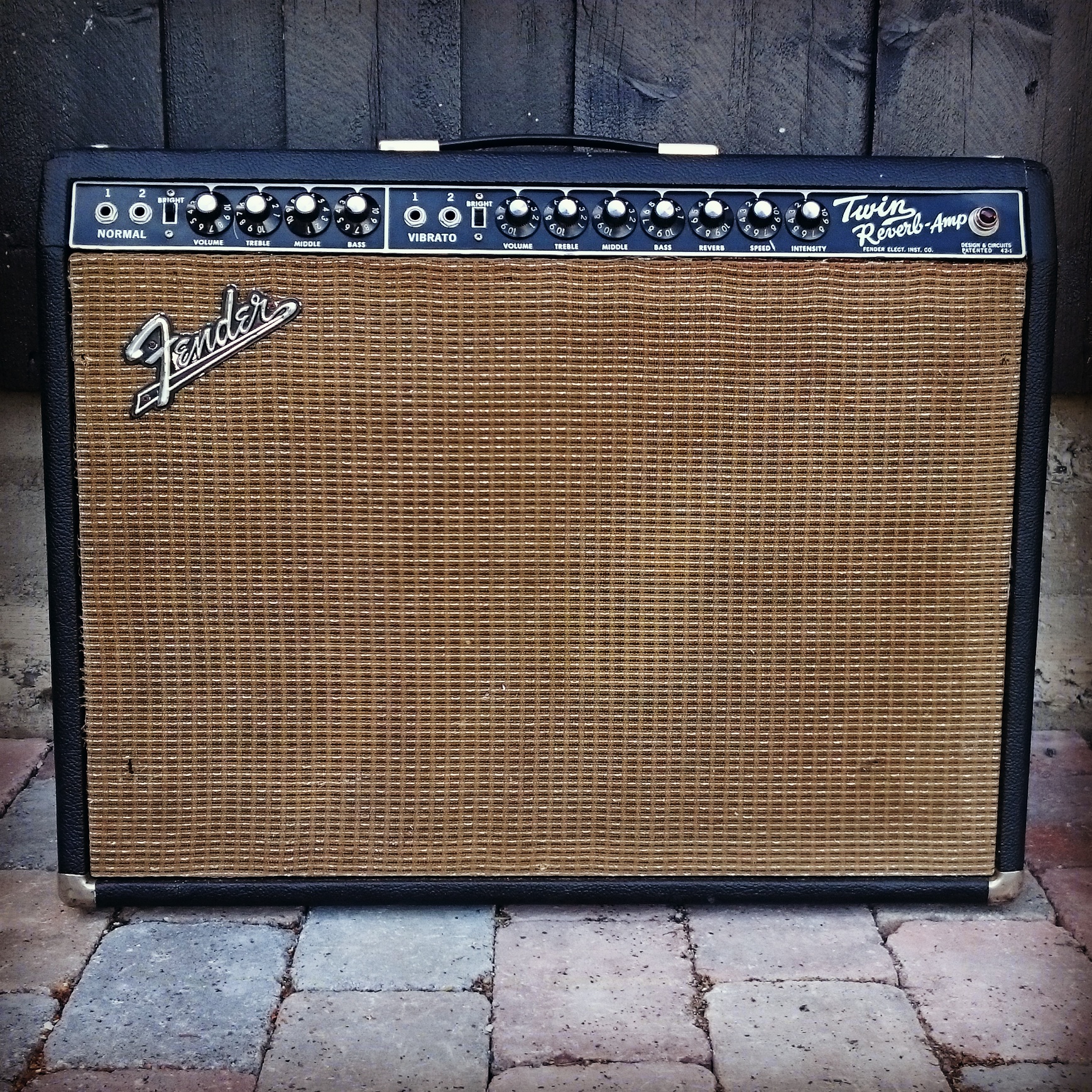
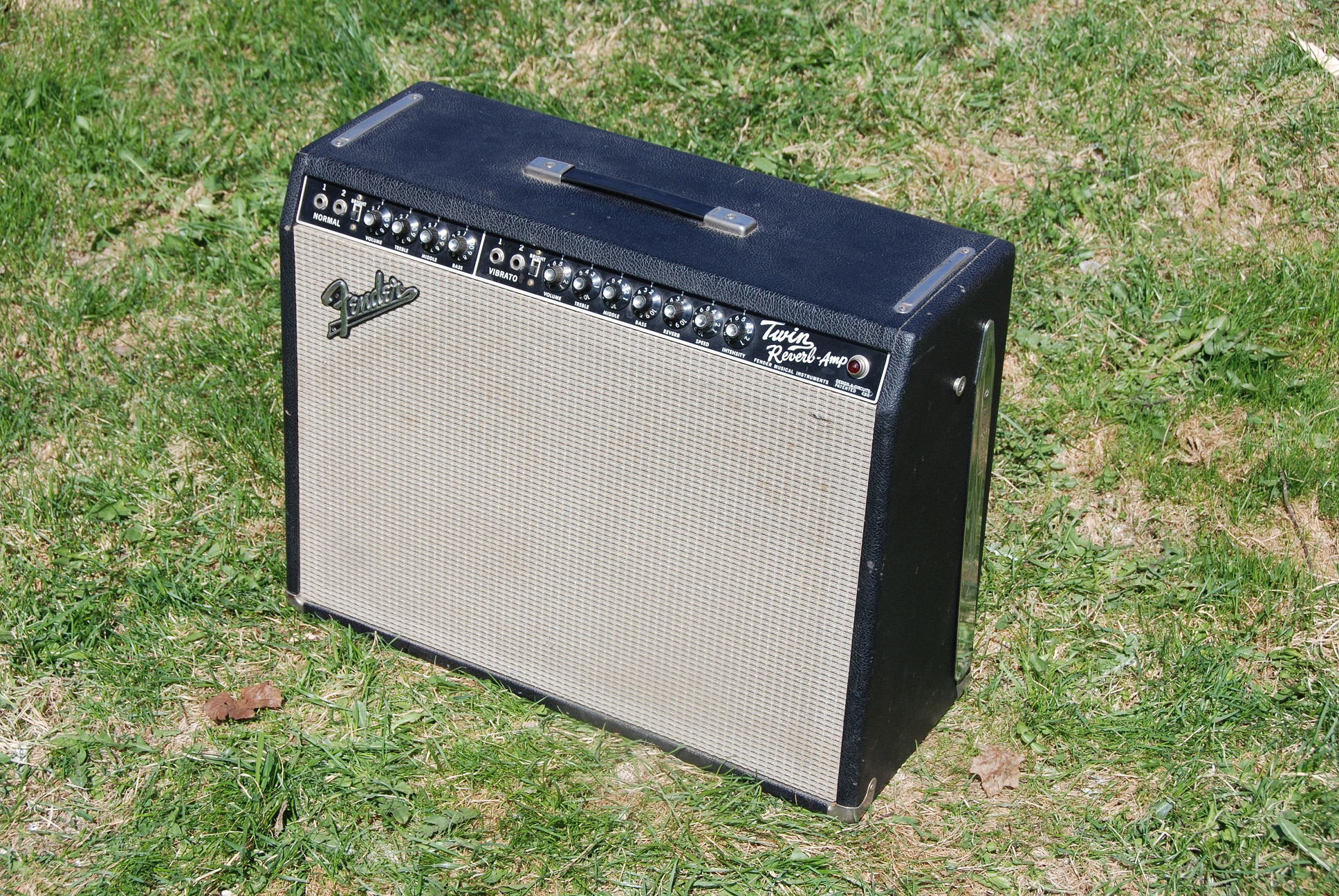
Production years:
- 1964 -1967 blackface circuits AA763, AB763
- 1968 -1982 silverface circuits AC568, AA769, AA270
Tube layout
AB763 Tube layout (Seen from behind, V1 is to the right side)
- V1 12ax7 = Preamp normal channel
- V2 12ax7 = Preamp vibrato channel
- V3 12at7 = Reverb send
- V4 12ax7 = 1/2 Reverb recovery and 1/2 gain stage for vibrato channel
- V5 12ax7 = Vibrato
- V6 12at7 = Phase inverter
- V7 6L6 = Power tube #1
- V8 6L6 = Power tube #2
- V9 6L6 = Power tube #3
- V10 6L6 = Power tube #4
Summary
” If an alien came to earth and wanted to hear an American guitar sound, I’d play him my Twin with a set of Jensens “. This was stated by a happy Twin Reverb owner on Harmonycentral.com. It could have been our own words.
The Twin Reverb is the king of Fender blackface amps. Having two pairs of 6L6, the popular and traditional two-channel AB763 circuit design, a diode rectifier and enormous transformers (power & output), it offers tons of clean headroom and volume for unmiked gigs and really big stages. Where the other Fender amps break up at around 4 on the volume knob, the Twin stays clean up to almost 6 and will hold up against heavy drummers and bass players with clean notes sharp as a knife edge. This is exactly what the amp is made for, being played unmiked in in a gospel band in a 300-seat church every Sunday. It is designed not break up like the other Fender amps. You need to have your expectations set correctly to be able to appreciate the evil Twin. Warning nr 1) Weight. The big transformers and speakers makes this amp weigh around 40 kgs, a burden too big for many gigging players who cannot (yet) afford a crew of roadies. Warning nr 2) Volume and clean headroom. If you want tube amp breakup and smoking tones with no pedals you will experience many fights with your band mates and club owners. Just as the other Fender amps the Twin needs to operate in its sweet spot up to sound sweet. After carrying a Twin Reverb on to the stage, the least you should deserve is to crank the bastard. Sadly, we are seldom offered the opportunity to turn the volume above 3 on a Twin Reverb. Instead we have played many nights with a thin and unpleasant tone, even worse with a sparkling, clean sounding strat. If you are one of these players, you should find some mods on this page interesting. With just a few simple tricks you can make your Twin break up earlier like the more versatile Pro Reverb 2×12″ and Deluxe Reverb 1×12”.
You’ll need schematics to implement some of these mods. http://www.ampwares.com/fender.asp. We usually start with explaining a mod from a functional perspective where we relate to components in the logical schematics diagram. Finally we point out location of components in the physical layout diagram.
Five fundamental tricks to create the holy grail of Fender tone
Here is a video demonstrating the effects of some of the mods and tricks described here. To see embedded text comments, go to video on Youtube.
Speakers
Below is a 65 Blackface Twin Reverb with its Oxford 12T6 speakers.
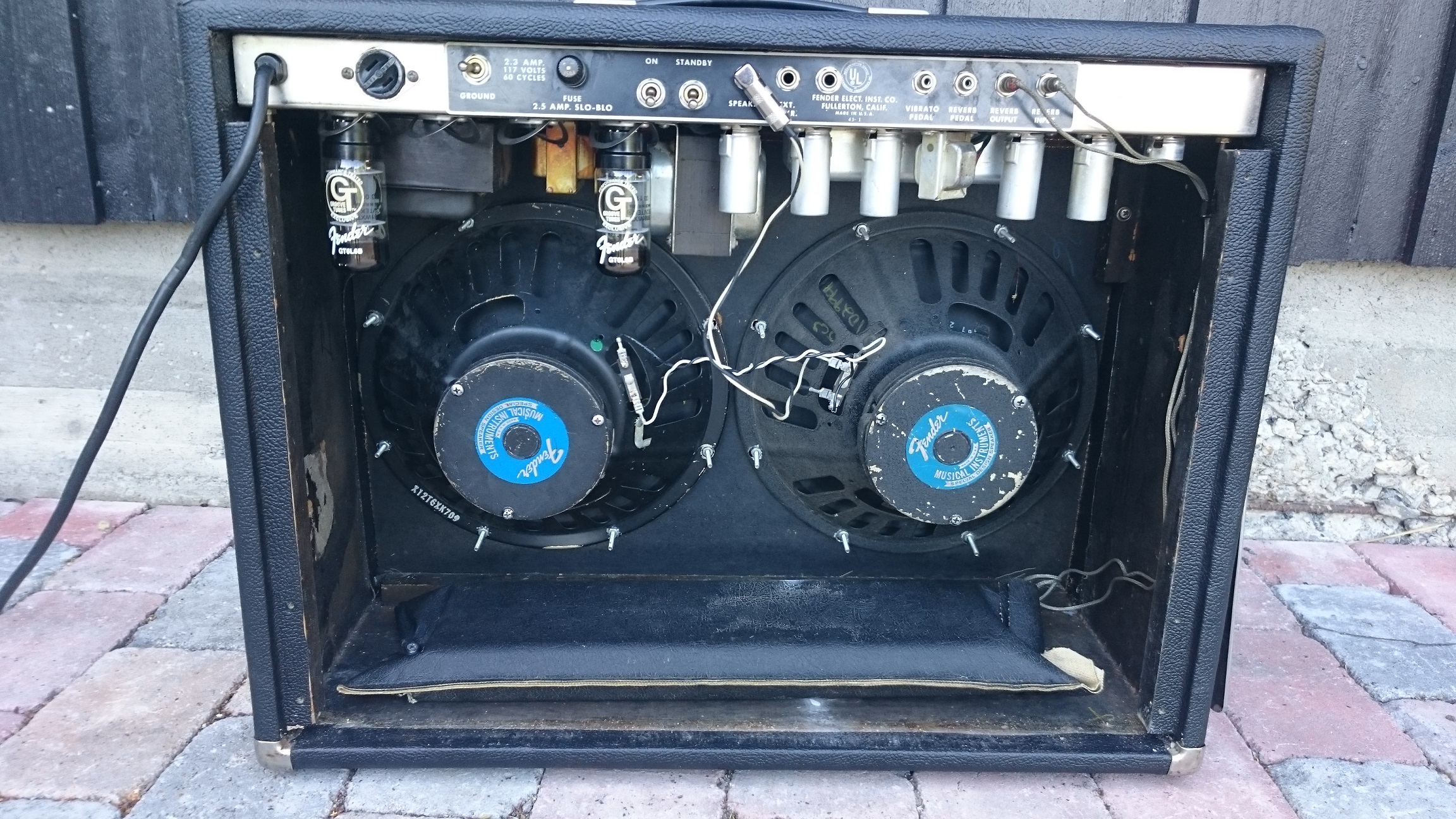
The blackface Twin Reverb came originally with Jensen C12n, Oxford 12T6 or JBL d120f. We have observed that the Jensens are considered as very good speakers both tonewise and in terms of robustness. The Oxford 12T6 are also superb speakers, a lot better than the 12L6 found in many Pro Reverbs and Deluxe Reverbs. They’ve got all what it takes, punch and sparkle. In a 50 year old vintage amp the condition of the speakers varies a lot. We’ve heard poor Jensens too. To those who are both players and collectors we would recommend to recone the speakers if you’re not happy with the tone. You may get a pair of vintage speakers to sound much better than they originally did in the 60s and 70s A64 Twin with Oxford 12T6. Installing high or low efficient speakers depends totally on your need for volume. If your plans are to play with lots of distortion at moderate volumes without being extremely loud, we recommend staying away from powerful and big sounding speakers (like EVM12L, Jensen C12N/K, Eminence Swamp Thang). Instead you should go for less efficient, “vintage” type speakers, perhaps with a dark frequency response if you are planning to play the amp beyond its sweet spot. Darker speakers tend to smoothen out the preamp and power amp tube distortion. For clean tone you should seek more neutral and transparent speakers. A nice trick is to pair different speakers, one vintage type and one more powerful. At some occasions we must admit that we get excited and fire up our Twin and Pro Reverb with speakers like EVM12L, Warehouse Veteran 30 or Eminence Swamp Thang. The punch of a big tone is amazing when coming from a big cabinet. Beware of the weight, though. The Twin Reverb will be around ~40kgs with heavy speakers, and therefore we prefer light speakers ourselves. Again, installing high or low efficient speakers depends totally on your need for volume. The TR can be really loud and even interfer with the bass guitar. A simple trick is to disable one of the speakers for less volume and earlier breakup. Not only do you reduce the speaker areal and bass tones, the tubes are pushed harder since they see a 8 ohm load in stead of 4 ohm through the output transformer. You’ll achieve sweet spot at a lower volume. Check this video to hear a 1969 AB763 Twin Reverb loaded with 2×12″ WGS G12c (video on Youtube).
See page How to select speakers for general speaker recommendations. Check this video to hear a 1966 blackface Pro Reverb 2×12″ with Jensen C12n (video on Youtube).
Half power mod – Pull out two 6L6 and disconnect 1 speaker.
Pull out the two inner 6L6 tubes and you have a ~40-50W amp. You should/can also disconnect one of the speakers to not have an impedance mismatch. The Twin reverb output transformer is designed to work most efficiently with the following impedances/loads and tube power configurations:
- 4 x 6L6 -> 4 ohm speaker load. And then comes the standard Fender +100% / -50% tolerance.
- 2 x 6L6 -> 8 ohm speaker load. And then comes the standard Fender +100% / -50% tolerance.
The plate voltage will increase a little when two of the tubes are removed. Ideally you should have the amp re-biased to not run the two remaining tubes too hard. The voltage levels on the plus- and minus-sides of the output transformer’s primary circuit remains the same whith two and four 6L6 tubes. But the delivered current is doubled with four tubes. Hence, the power is also doubled. Power (Watts) = Current (Amperes) x Voltage (Volts). This mod is a must-know survival trick for all Twin owners.
12AY7 or 12AT7 as preamp tubes – Less preamp gain.
If you want cleaner and spankier preamp distortion characteristics, you may replace the V1 or V2 12AX7 preamp tube with 12AT7 and 12AY7. These tubes have different frequency responses than 12AX7, particularly when distorting. People describe these tubes to have less harsh and buzzy distortion. This mod does not alter the tone significantly when amp is played clean or when only the power amp section distorts. You’ll have to increase the volume setting to achieve a similar volume as before. The reason is that 12AX7 tube has a voltage gain factor = 100, while 12AT7 = 60 and 12AY7 = 45.
Pull out the V1 normal channel preamp tube – More preamp gain in vibrato channel.
We’ll start with saying that this is a mod we personally do to all dual channel blackface, silverface and reissue amps. It is so easy to enable and disable that it can hardly be called a mod. If you are like most players and only use the Vibrato channel (reverb, tremolo, the bright cap and the extra gain stage), you should pull out the V1 tube. This is the preamp tube for the normal channel which you are not using when playing the Vibrato channel. Vice versa; If you’re using the Normal channel, you can pull out the V2 tube. All AB763-similar circuits (Deluxe Reverb, Super Reverb, Pro Reverb, Twin Reverb, Vibroverb, Vibrolux) are designed so that they share the cathode cap and resistor (25 uF/1500 ohm) and pulling one of the tubes will changes the effective value of the resistor they both share. If you pull one tube the other channel’s tube will be hotter biased and offers more gain. The amp will play louder than before given the same volume knob setting. The stronger signal will push the second gain stage (V4 tube) harder and give you increased sustain, compression and harmonics. This mod does not change the amp’s clean headroom but increases the preamp gain and preamp distortion. This mod is one of Cesar Diaz’ tricks in the Fender Custom Shop Vibroverb 64 which he always did to Stevie’s amps. This mod is safe. It has stood the test of time and been been done by players in 50 years in blackface Fender amps.
Replace the 12AT7 PI tube with a 12AX7 or 12AU7 – Less clean headroom.
Very practical mod at practice and low volume environments. This mod reduces the amp’s clean headroom and you’ll achieve sweet spot at a lower volume. You’ll notice that the amp gets looser and with less attack. Tips: If you pulled the V1 12AX7 tube you may use it as V6 phase inverter. 12AX7 as phase inverter tube will give the most effect out of this mod. 12AU7 will be in between 12AT7 and 12AU7.
Replace the 12AT7 reverb driver with 12AU7 – Better reverb control.
Reverb is an important character with vintage amps, yet so individual and mysterious. We all know that speakers change their tonal character during age. So does the reverb. The reverb function sounds and behaves differently between “identical” vintage amps. Some amps have long, lush and soft reverb while others are mushy and overwhelming. We often find the reverb sweet spot around 2.5 on the reverb pot, varying from 2 to 4. Some amps are sensitive and difficult to control the reverb on. The whole dynamic area can be within a narrow interval, i.e. 2 and 2.5. These amps require a careful touch when dialling in the reverb, which irritates us. The reverb circuitry consists of two tube sections (reverb driver V3 and reverb recovery V4) and the physical reverb tank. All these components will drift during age and minor differences in component values are noticeable to man’s ear. If you replace the V3 12AT7 reverb driver with a 12AU7, you will reduce the effect of the reverb and it will be much easier to control with the reverb knob. So simple as that.
Use normal channel for reverb control – Adjust EQ and depth of reverb.
This mod is relevant only for two-channel amps with normal and vibrato channel. This trick is great for the reverb enthusiasts among us, and who is not? Plug your guitar into the vibrato channel, then unplug the reverb return cable on the back of the amp (the one that comes from the reverb tank output) and plug it into the normal channel input. You will need a converter to go from male phono/RCA jack to a 1/4″ male jack. You may now use the normal channel as a reverb control where you can adjust the depth and tone using the volume, bright switch, treble and bass knobs (and mid if you have a Twin Reverb). The reverb knob on the vibrato channel will have no effect any longer. This mod is not applicable together with the Pull V1 mod, as you need the normal channel preamp tube.
Tremolo disconnect mod – More preamp gain in vibrato channel.
The effect of this mod is similar to pulling the V1 normal channel preamp tube when playing the vibrato channel. This is also a very popular mod in AB763-similar circuits (Super, Twin, Vibroverb, Pro Reverb, Deluxe, Vibrolux). By original design the tremolo circuit will absorb current/signal even when one turns the tremolo off with the footswitch. This mod suggests to entirely disconnect the tremolo circuit from the signal path by replacing the tremolo intensity pot with a switchable pot (spst). One side effect with this mod is a noticeable click and a volume difference between tremolo on and off using the new spst pot. If one uses the tremolo regularly one should still use the tremolo pedal to enable/disable the tremolo and leave the intensity spst pot at your desired level. The spst pot is not good for enabling and disabling the tremolo very often (because of the click and the volume difference) but is a nice when you play without tremolo. A good thing with this mod is that you have both the tremolo pedal and spst pot to use. With a new switchable/spst pot set at intensity=0 the mod will kick in and raise the signal level in the preamp section, right before the phase inverter. Once you’re turning up the tremolo the circuit is connected again and the tone will remain original. This mod does not increase the amp’s clean headroom. We would describe the effect as making the tone richer, fuller and more powerful with stronger mids that pushes the power amp section harder (phase inverter + power tubes). We like this mod a lot for stratocasters wi the Fender AB763-similar circuits since they boost a relatively scooped and thin sounding guitar and amp. In addition to pulling the V1 tube, this mod is one of those must have mods which we never undo once having implemented it. This mod is one of Cesar Diaz’ tricks in the Fender Custom Shop Vibroverb 64 which he always did to Stevie’s amps. This mod can be implemented in two ways, either by unsoldering the tremolo circuit or replacing the tremolo intensity pot with a switchable pot, so-called SPST pot. The switch is enabled when you turn down intensity to zero. There are also switchable push/pull pots where you pull the knob to enable the switch.
- Order a 50k SPST from one of our recommended amp part dealers.
- Remove the original 50k trem intensity potmeter by unsoldering the wires to the potmeter lugs and unount the pot from the chassis. The black plastic wheel is to be used for the new pot.
- Install the new 50k SPST pot to the chassis. This is a switchable pot offering a mid positioned switch in addition to the variable resistance 0-50 KOhm between the lugs. At level=0 you’ll completely disconnect the tremolo circuit.
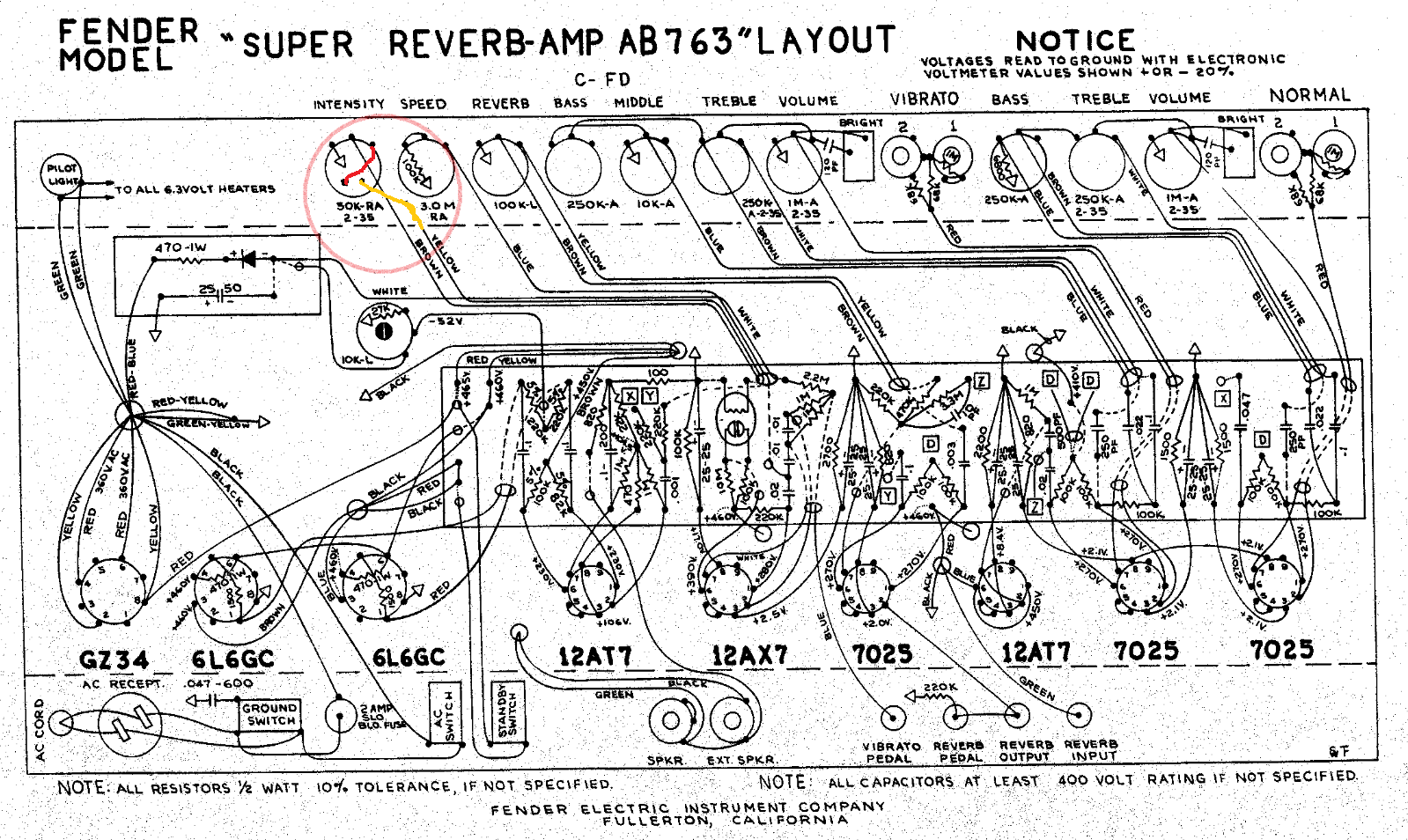
- See the wiring diagram below.
- You’ll have to solder the yellow wire to one side of the mid positioned switch instead of to the right pot lug as before.
- Then solder a new (red) wire between the other side of switch to the right lug.
- If you’re permanently disconnecting the tremolo circuit you can just clip of the brown and yellow wires and insulate the ends with tape. Note that the figure below shows the Super Reverb. The Twin Reverb would be the same.
One may also use the tremolo pedal, instead of the spst switch/pot, to entirely disconnect the tremolo. You will not need to replace the intensity pot with a spst, but let the yellow wire to the tremolo pot go through the tremolo pedal. In our opinion this is not a good idea since one loses the possibility to use both the spst switch and tremolo pedal. Using the pedal will now involve a significant click sound and volume increase.
Blackfacing
The differences between AA763 and AB763 are discussed in the Super Reverb section and we won’t repeat that here. As for the Super Reverb we would recommend the AB763 circuit as target if you attempt to blackface a silverface circuit.
AC568 vs AB763
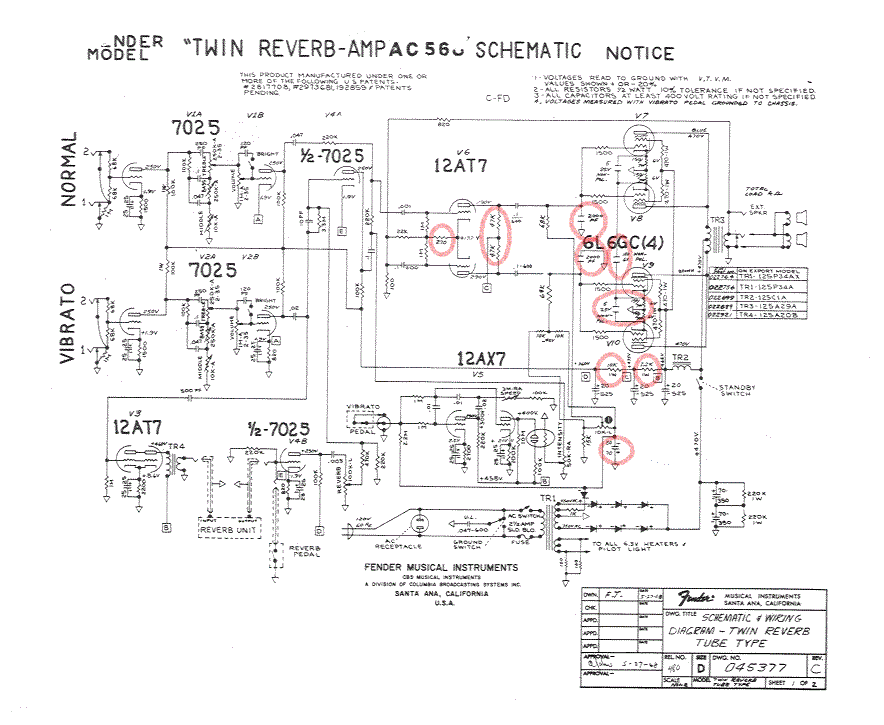
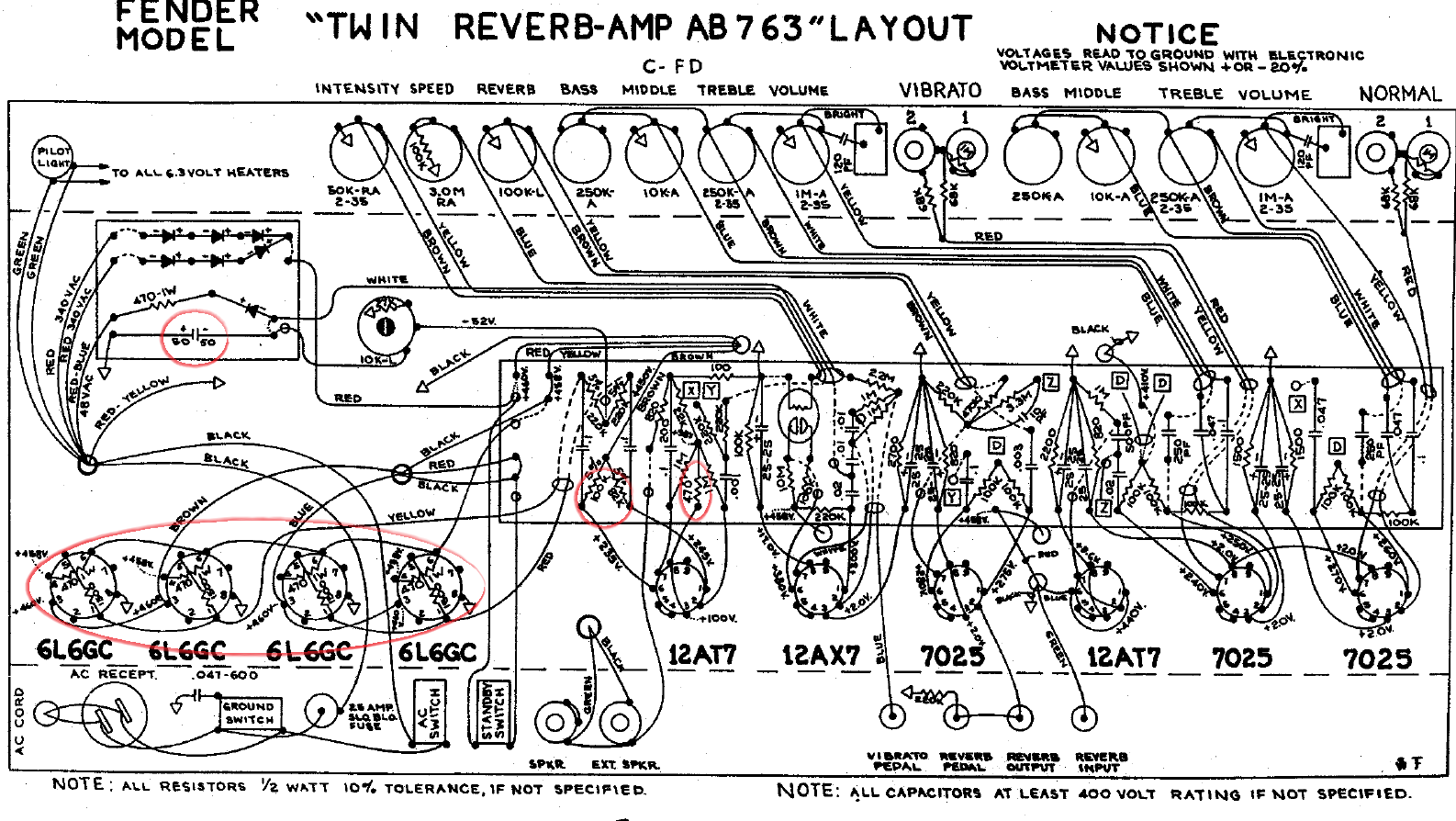
The changes are marked with red circles in figure below. We comment every circle also.
- Bias electrolytic cap was changed from 50?F/50V to 50?F/70V in AC568. Tone not affected.
- The voltage divider resistors (in filter cap circuit) was changed from 1KOhm and 4.7KOhm to 2.2KOhm and 10KOhm.
- 2200pF caps on 6L6 grids were introduced. Leaking high frequencies to ground means less distortion and cleaner tone.
- Cathode caps on 6L6 tubes were introduced, as well as caps connecting the two pairs of 6L6. Values are not readable. Also attempt to eliminate distortion.
- Phase inverter plate resistors changed from 82K/100K to 47K/47K. Also the 470 Kohm resistor in PI circuit was changed to 220 K.
Logical schematics (showing the AC568):
Layout (showing the AB763):
Click images for full size versions.
Negative feedback loop
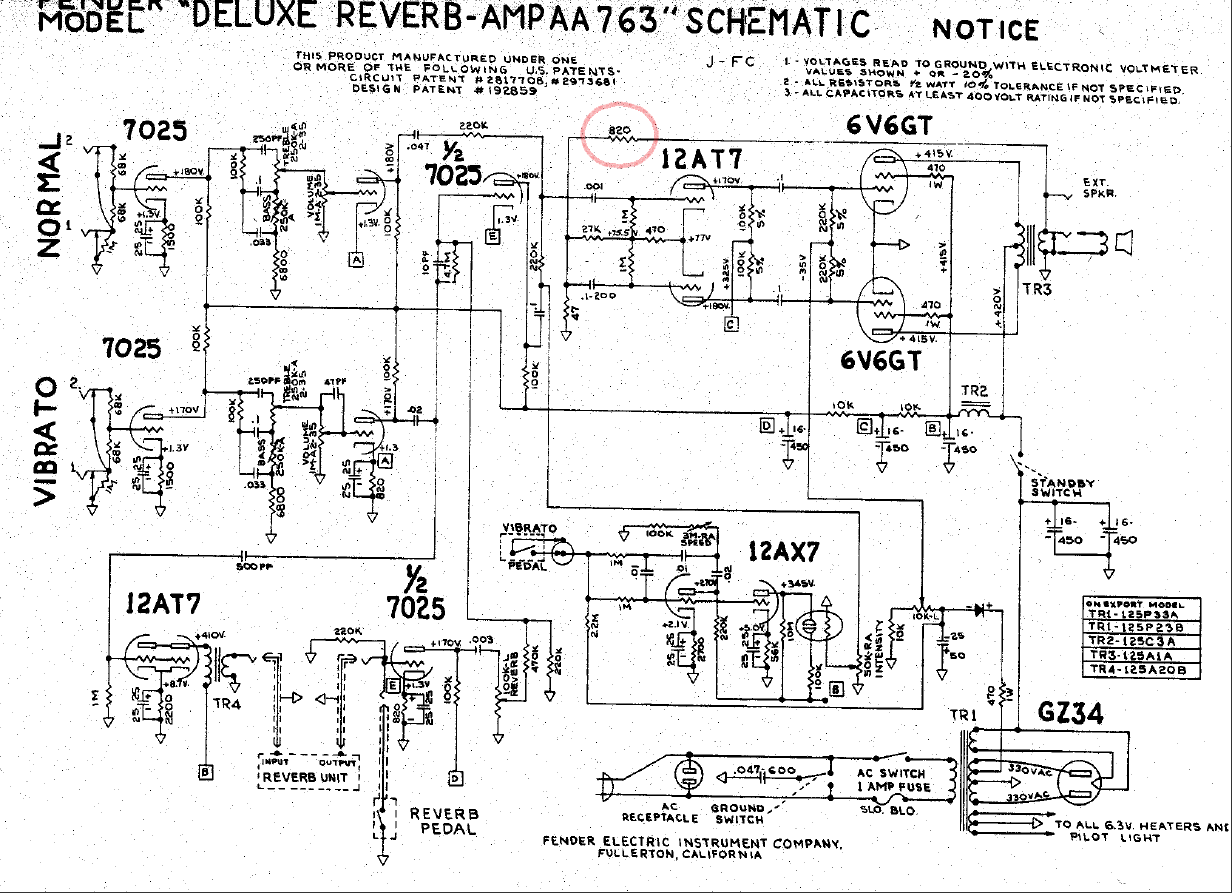
The negative feedback loop can easily be tweaked to alter the treble cut and distortion in your amp. The purpose of the NBF loop is to clean up the tone and cancel out the mid/higher frequencies and upper harmonics (distortion) at the entry point of the phase inverter which is placed in front of the power tubes. The NBF theory is that you take the signal from the speaker output, let it go through a resistor and mix it in at the entry point of the phase inverter. The speaker signal is out of phase (180 degrees) with the signal at the entry point of the phase inverter and will cancel out equal frequencies. If you disconnect the NBF loop you’ll notice that the volume increases and tone gets much more aggressive. More white noise too. unfortunately, which is why there is a NFB loop. You will fin the amp’s sweet spot at a lower volume knob setting without the NFB loop. Not only is there a volume shift, the amp’s clean headroom is reduced slightly. Most importantly the tone gets rougher and rawer with more mids and higher frequencies, aka presence. If you think your tone is too bright or harsh or you’re seeking a mellow and nice clean tone, you probably want to keep the NBF loop. This mod is for those who want more bite and a tone that really cuts through in the mix.
You may choose to implement the mod in several ways and in various combinations with the ground switch or a foot pedal. A foot pedal works like a boost/FAT pedal. If yo’re struggling to find a transparent boost pedal that keeps the natural Fender tone you should try this out. You will still have that beautiful Fender tone, just more and wilder.
- No negative feedback at all. Simply disconnect the feedback loop (a wire) and tape insulate it. You get the most effect of this mod by disconnecting the NFB loop entirely. You may experience that the tone gets harsh, depending on guitar, speakers and EQ settings of course. If so, read more about the cap in the next bullet point.
- Keep the feedback loop and install a .01 µF in series with the NBF resistor. This cap will prevent the lower and mid frequencies to go through the NFB loop. Depending on the cap value treble frequencies will be fed back to the phase inverter which cancels out the treble in the main path. The tone gets less harsh and you still have a noticeable effect. You should experiment with different cap values. Start with 0.01µF.
- Increase the feedback loop resistance value. A good starting point is twice the original resistor value. This reduces the effect of the feedback loop, making the amp break up more when the NFB is engaged. If you make the NBF switchable there will be less volume difference if you use a high resistor value. (Using a .01 µF cap is also recommended to minimize the difference a little bit between NBF on and off).
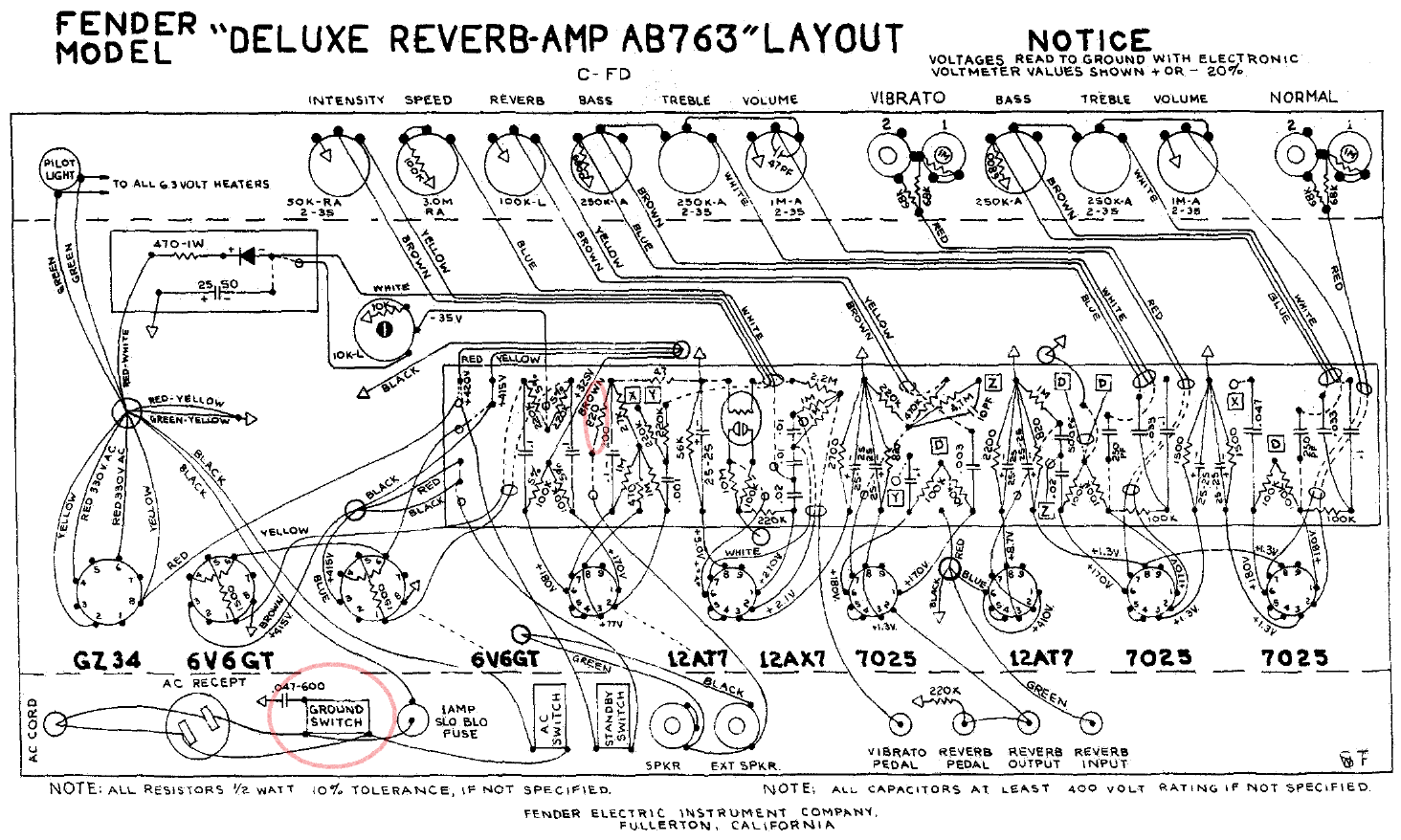
- Use the ground switch or foot pedal to make the NBF switchable. If you remove the death cap and free up the ground switch by removing existing wires to it (if you’re wondering what the ground switch does, you don’t need it). Then wire the ground switch in series with the NBF resistor. If you’re using a cap in the NBF loop this goes across the switch allowing treble to bypass independent of the switch. When the ground switch has disconnected the NBF loop the higher frequencies are still fed back through the cap. In practice you solder each the two cap legs to at each side of the switch between speaker terminal and NFB resistor.
Where to install foot-pedal or switch? The ground switch is easy available if you disable the power supply wires and death cap. For amps with reverb you could use the reverb footswitch phono plug if you are not using it.
Logical schematics
Layout
Click images for full size versions.
Multiple and flexible speaker output impedances (built-in attenuator)
This mod requires the knowledge of how to replace a transformer in your amp. The mod will give you multiple and flexible speaker output impedances where the external speaker output jack serves as a secondary independently speaker output. This flexibility is desirable when combining the inbuilt speakers together with an extension cabinet.
The original OT in a TR is sized for a 4 Ohm speaker impedance (2×12″ @ 8 ohm). It will make sure the power tubes “see” the correct impedance and can operate at optimal conditions in terms of clean headroom potential and frequency response. If you were to replace the original OT with a 2 ohm OT, the tubes will be pushed harder since they see a bigger load than expected (the tubes see the speakers through the OT). Both the volume and clean headroom will be reduced, yet the tone stays fairly the same (some clarity may be lost). This effect is similar to an attenuator, which is very nice when you want to achieve the amp’s sweet spot at a lower volume.
- In a 2×12″ @ 8 ohm speaker configuration, we recommend 4 ohm + 2 ohm output impedances.
- In a 1×12″ @ 8 ohm speaker configuration, we recommend 8 ohm + 4 ohm output impedances.
- Go to Mercury Magnetics website. Order the Twin Reverb multi-tap OT with 2, 4 and 8 ohm taps.
- Remove the original OT carefully and store it away. Install the Mercury Magnetics OT.
- Wire the OT’s primary circuit just as before. Clip the cables nicely and twist them as Leo Fender’s gently old ladies did. Insulate the unused ones with tape.
- The OT’s secondary circuit will be wired differently. Wire the 4 ohm tap to the main speaker jack. Then wire the 2 tap to the ext speaker jack. You must first remove all existing wiring on the external speaker jack so that it is totally separated from the main speaker jack.
- Now you have two speaker outputs; 4 ohm + 2 ohm. You may use them independently and the ext speaker jack does not require the main speaker jack to be plugged.
We like this mod a lot. Especially since we’re using the original jack outputs. Choosing the 2 ohm output with two 8 ohm speakers (4 ohm) in will attenuate the volume a lot at practise and gigs.