
Production years:
- 1964 -1967 “blackface” circuits AA763, AB763
Tube layout
AA763/AB763 Tube layout (Seen from behind, V1 is to the right side)
- V1 12ax7 = Preamp normal channel
- V2 12ax7 = Preamp vibrato channel
- V3 12ax7 = Vibrato
- V4 12at7 = Phase inverter
- V5 6V6 = Power tube #1
- V6 6V6 = Power tube #2
- V7 GZ34 = Rectifier tube
Summary
The Blackface Deluxe Amp is often misinterpreted as a Deluxe Reverb without reverb. It might seem so if you take a look at the front panel and the knob functions. But a closer study of the circuit design will reveal that the Deluxe Reverb vibrato channel has the extra gain stage (one half of the 12AX7 V4 tube) common for the Fender reverb amps. The wet reverb signal is mixed together with the dry signal which has gone through the 3.3 MOhm resistor, therefore needing a gain boost before entering the phase inverter. This means one less tube in the Deluxe Amp in the preamp section that will contribute to sustaining harmonics, compression and sag. The Deluxe-Amp is therefore cleaner when played high on the volume knob. Still, the clean sound of these amps sound fairly similar given a common EQ circuitry, phase inverter and power amp section. When the volume is pushed beyond 4-5 where the amps will differ in tone. The Deluxe will remain relatively clean, while the Deluxe Reverb breaks up in a typical blackface manner. Being a middle size Fender blackface amp the Deluxe has not been modified and experimented with so widely as other Fender amps. It’s power, clean headroom, physical size and tonal characteristics have matched the expectations of more players than any other tube or transistor guitar amp of any brand on this planet. It is said that the Deluxe Reverb is the nr 1 most used amp in recording studios. We can understand why. It is powerful enough to cut through in a band with a drummer and reaches the sweet spot at a reasonable volume. It has the typical blackface 60’s sparkling, scooped clean sound as it’s bigger brothers, just with more smooth breakup, sag and compression. The smaller brother Princeton Reverb is rolling off more top frequencies and breaks up earlier with more warmth producing a brownface type of tone. It can not really cut through with Albert Collins’ icy licks like the Deluxe.
In general we don’t recommend the mods that increase the power and clean headroom unless you are playing your amp at gigs on medium/large stages and you need more of the sparkling clean notes or funky rhythm chords to cut through. If you are using your amp at home or in recording situations we think you’ll be very happy with a stock Deluxe. You will be able to shape your tone just by selecting the correct speaker(s) and some experimenting with tubes.
You’ll need schematics to implement some of these mods. http://www.ampwares.com/fender.asp. We usually start with explaining a mod from a functional perspective where we relate to components in the logical schematics diagram. Finally we point out location of components in the physical layout diagram.
Speakers
See the Deluxe Reverb page for an introduction to speakers with this amp. Also see page How to select speakers for general speaker recommendations.
12AY7 or 12AT7 as preamp tube – Less preamp gain.
If you want a cleaner and spankier tone you can replace the V1/V2 12AX7 preamp tube with 12AT7 or 12AY7. These tubes have lower voltage gain and different frequency responses, particularly when distorting. 12AX7 tube has a voltage gain factor = 100, while 12AT7 = 60 and 12AY7 = 45. One could describe these tubes to have less harsh and buzzy distortion. This mod does not alter the tone significantly when amp is played clean’ish. You’ll have to increase the volume setting to achieve a similar volume as before. If you hit sweet spot at volume=4 with 12AX7 you may go as high as 6-7 before reaching it with 12AT7 or 12AY7.
Pull out the V1 normal channel preamp tube for more preamp gain in vibrato channel
We’ll start with saying that this is a mod we personally do to all dual channel blackface, silverface and reissue amps. It is so easy to enable and disable that it can hardly be called a mod. If you are like most players and only use the Vibrato channel (reverb, tremolo, the bright cap and the extra gain stage), you should pull out the V1 tube. This is the preamp tube for the normal channel which you are not using when playing the Vibrato channel. Vice versa; If you’re using the Normal channel, you can pull out the V2 tube. All AB763-similar circuits (Deluxe Reverb, Super Reverb, Pro Reverb, Twin Reverb, Vibroverb, Vibrolux) are designed so that they share the cathode cap and resistor (25 uF/1500 ohm) and pulling one of the tubes will changes the effective value of the resistor they both share. If you pull one tube the other channel’s tube will be hotter biased and offers more gain. The amp will play louder than before given the same volume knob setting. The stronger signal will push the second gain stage (V4 tube) harder and give you increased sustain, compression and harmonics. This mod does not change the amp’s clean headroom but increases the preamp gain and preamp distortion.
This mod is one of Cesar Diaz’ tricks in the Fender Custom Shop Vibroverb 64 which he always did to Stevie’s amps. This mod is safe. It has stood the test of time and been been done by players in 50 years in blackface Fender amps.
Replace the 12AT7 PI tube with a 12AX7 or 12AU7 – Less clean headroom.
Very practical mod at practice and low volume environments. This mod reduces the amp’s clean headroom and you’ll achieve sweet spot at a lower volume. You’ll notice that the amp gets looser and with less attack. Tips: If you pulled the V1 12AX7 tube you may use it as V6 phase inverter.
12AX7 as phase inverter tube will give the most effect out of this mod. 12AU7 will be in between 12AT7 and 12AU7.
Diode rectifier – More clean headroom.
This mod is for those who wants more power, clean headroom and attack. It is very practical to bring with you those small Sovtek plastic adapters that easily can replace the rectifier tube. You’ll increase the power of the amp with a few watts. The diode rectifier will feed your amp’s filter caps with a higher and “faster” DC voltage compared to a tube rectifier. The fact that it delivers a slightly higher DC voltage to your power tubes (via the filter caps) means an increase of the tube voltage gain factor. When you hit a hard chord the preamp and power tubes will require energy and current is flowing from the DC filter caps which are charged up by the rectifier. If the rectifier can deliver more energy more quickly, you’ll have more power and attack.
Please be aware of that using gz34 or diode rectifier will wear you 6v6 power tubes faster than with a 5u4gb due to the higher plate voltage. Some 6V6 tubes are better than others in handling higher voltages. The TAD and JJs are rough and can take a lot of beating.
Check also out Ted Weber’s “Copper Cap Rectifiers” that emulates the sag of a tube rectifier.
Upgrade to 6L6 – More power and clean headroom.
If you want more power you can easily replace the 6V6’s with 6L6. You need to rebias the amp immediately to prevent wearing out the tubes. We recommend 32mA for 6L6 and 23mA for 6V6. We have only tried this mod on blackface circuits (AB763-similar) with GZ34 tube rectifier. This mod is very effective since it is quick and requires very little knowledge or tools. If you’re at a gig and need more clean headroom, just upgrade to 6L6 and rebias. Be careful with vintage speakers that easily blow when taking 30-35 watts in stead of 20. Both the power and output transformer in a Deluxe is smaller than the 40 watt amps, and you’ll have more sag and less attack.
This 6L6 mod is very effective together with a 2×10″ speaker baffle with 8 ohm speakers, which makes the Deluxe more or less a 2×10″ Vibrolux. You will then have a better impedance match and more effect utilized from the 6L6s. For low wattage gigs you can use only one of the 10″ @ 8 ohm speakers. For gigs that require a big clean sound you simply engage both speakers. You now have a 30-35W amp.
Tremolo disconnect mod – More preamp gain in vibrato channel.
The effect of this mod is similar to pulling the V1 normal channel preamp tube when playing the vibrato channel. This is also a very popular mod in the AB763-similar circuits (Super, Twin, Vibroverb, Pro Reverb, Deluxe, Vibrolux). When you’re not using any tremolo (intensity=0) this mod will kick in. Once you’re turning up the tremolo the tremolo circuit is connected and the tone is original. The tremolo circuit will draw current from your signal path whether it is in use or not. Hence, it reduces some of the gain that has been added by the preamp tube stages. This mod does not increase the amp’s clean headroom. We would describe the effect as making the tone richer, fuller and more powerful with stronger mids that pushes the power tubes harder. This mod provides a noticeable volume increase (and a bump) when enabled that you can compensate for by lowering the volume knob setting. Most important is the richer and fuller tone. We like this mod a lot in all AB763 circuits since they really turn alive a scooped and relatively thin sounding guitar and amp. In addition to pulling the V1 tube, this mod is one of those must have mods which we never undo once having implemented it.
This mod is one of Cesar Diaz’ tricks in the Fender Custom Shop Vibroverb 64 which he always did to Stevie’s amps. This mod can be implemented in two ways, either by unsoldering the tremolo circuit or replacing the tremolo intensity pot with a switchable pot, so-called SPST pot. The switch is enabled when you turn down to zero. There are also switchable push/pull pots where you pull the knob to enable the switch.
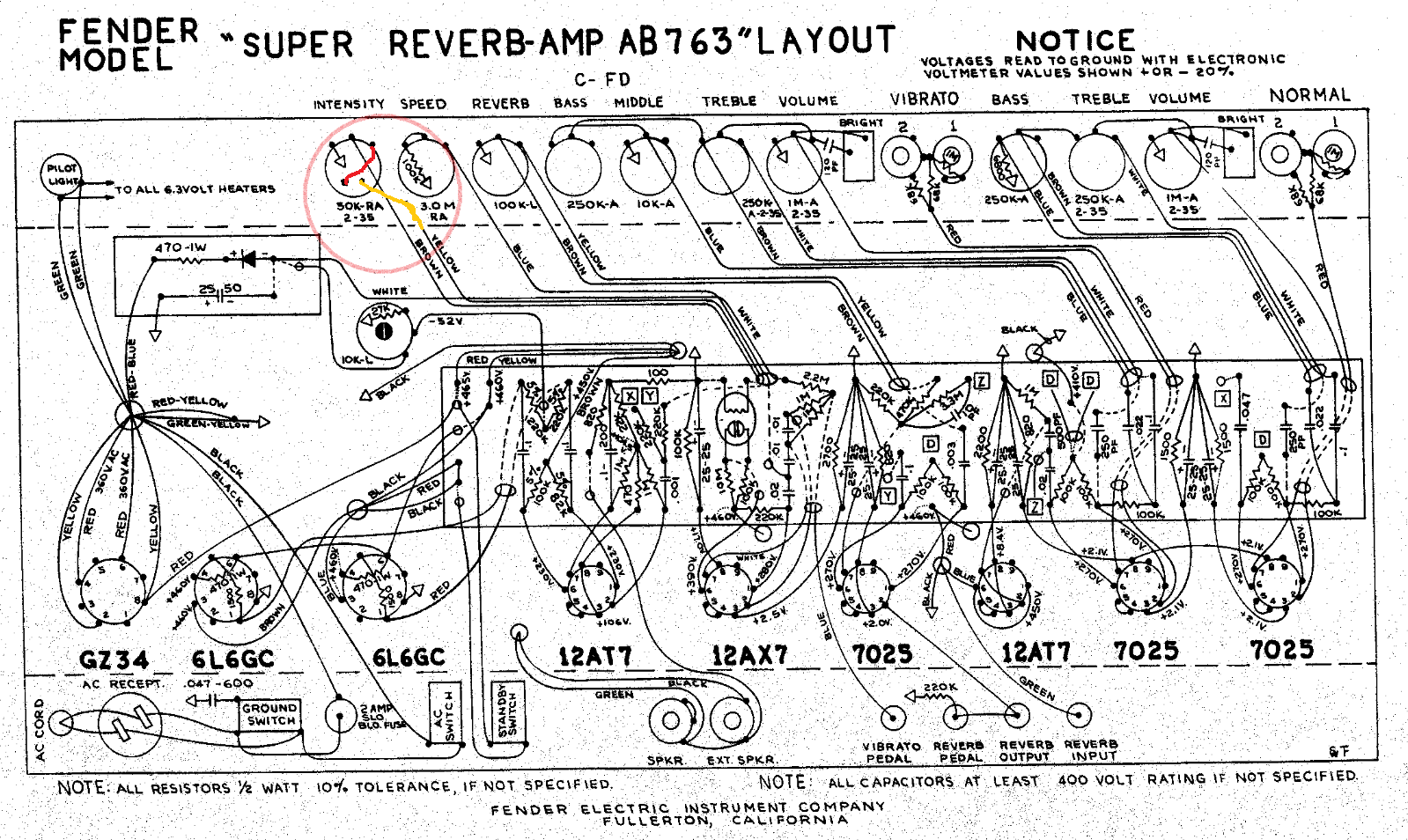
- Order a 50k SPST from one of our recommended amp part dealers.
- Remove the original 50k trem intensity potmeter by unsoldering the wires to the potmeter lugs and unmount the pot from the chassis. The black plastic wheel is to be used for the new pot.
- Install the new 50k SPST pot to the chassis. This is a switchable pot offering a mid positioned switch in addition to the variable resistance 0-50 KOhm between the lugs. At level=0 you’ll completely disconnect the tremolo circuit.
- See the wiring diagram below.
- You’ll have to solder the yellow wire to one side of the mid positioned switch in stead of to the right pot lug as before.
- Then solder a new (red) wire between the other side of switch to the right lug.
If you’re permanently disconnecting the tremolo circuit you can just clip of the brown and yellow wires and insulate the ends with tape.
Bright cap
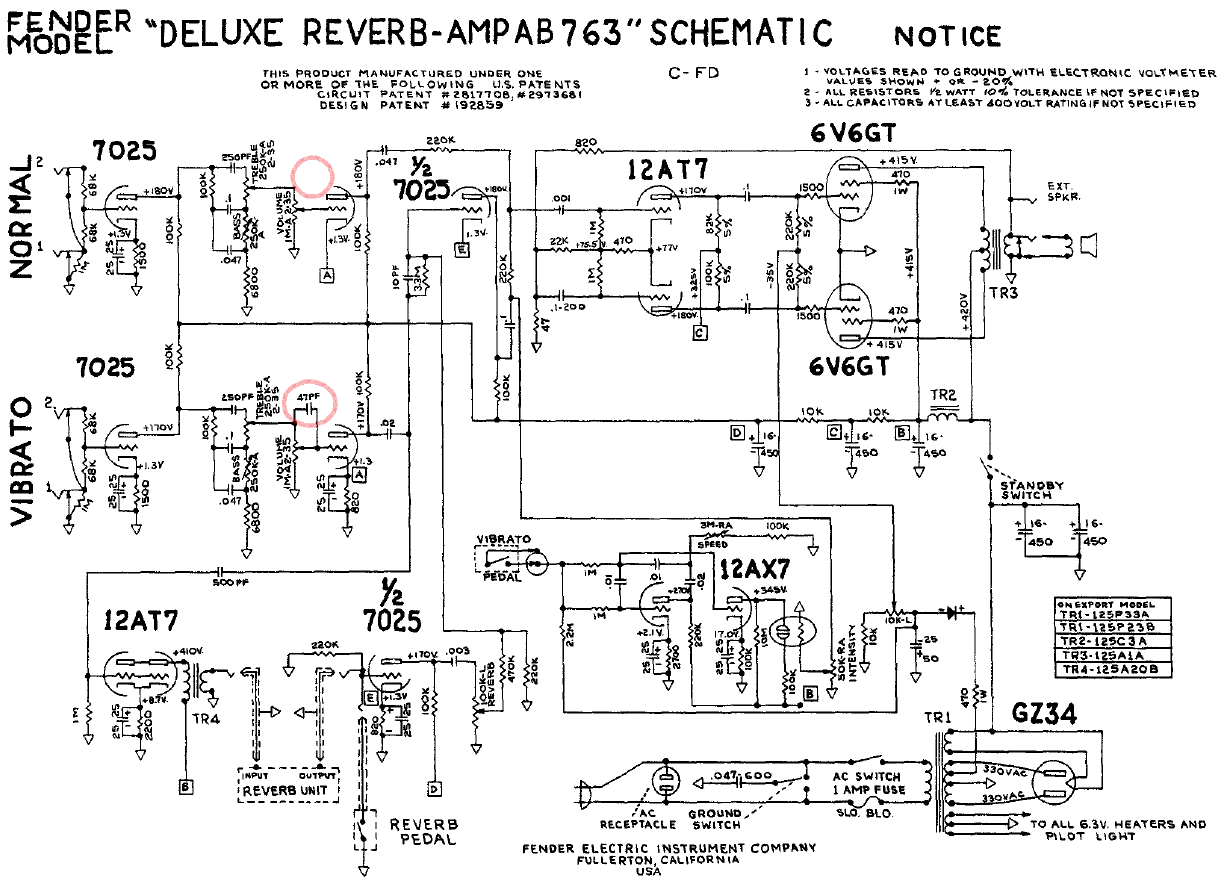
Unlike it’s bigger brothers, the Deluxe came with no bright switch. Instead there is a hard wired bright cap 47pF in the Vibrato channel enhancing the upper treble notes. The Normal channel did not get this bright cap. You may choose to clip one of the legs on this 47pF cap to turn the bright switch off, or you may want to install a identical bright cap to the normal channel. See red circles in figures below for this cap. The cap is installed directly between the volume pot lugs.
Schematics (Deluxe Reverb is showed, but the Deluxe will be the same in this context)
Layout
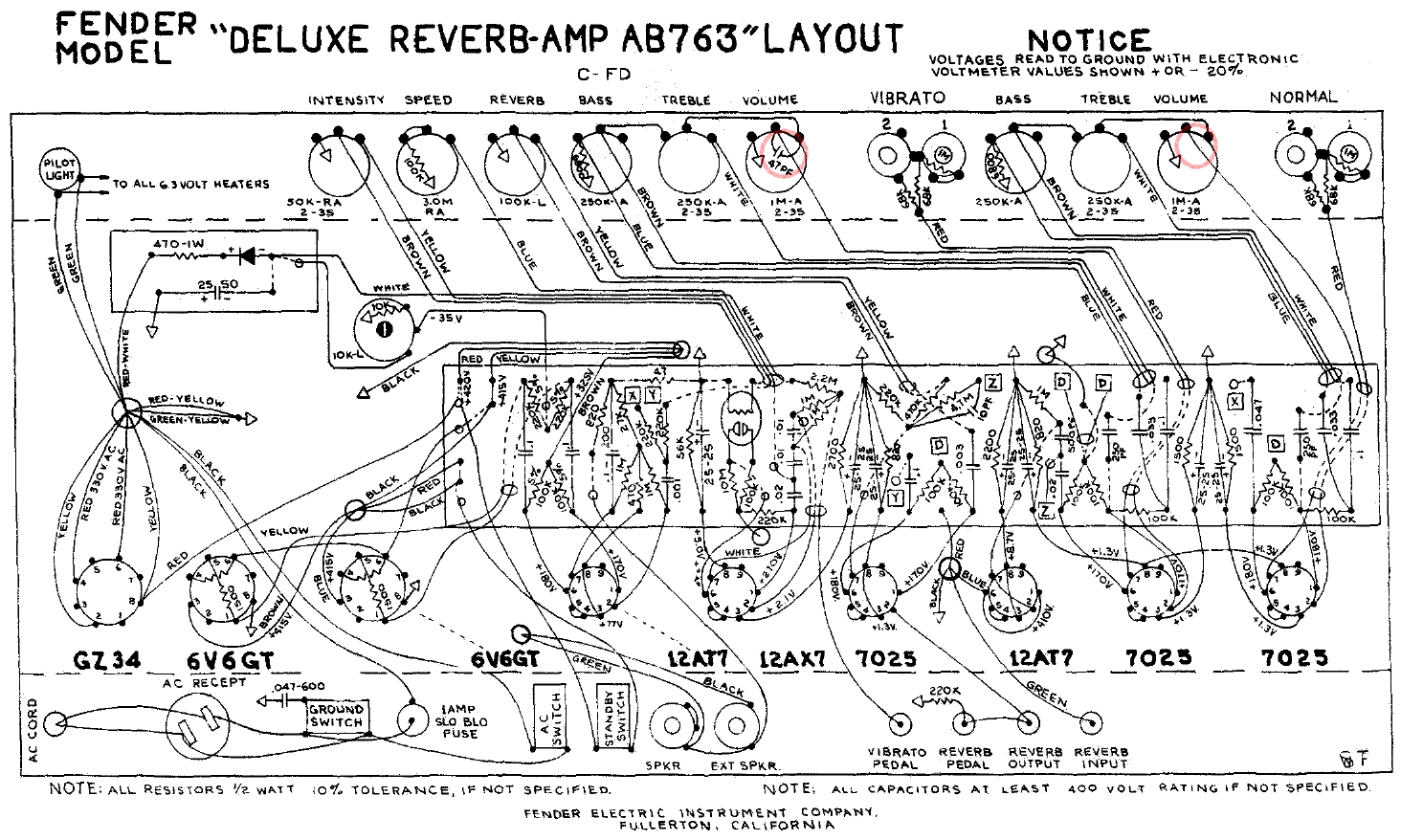
Click images for large versions.
Negative feedback loop
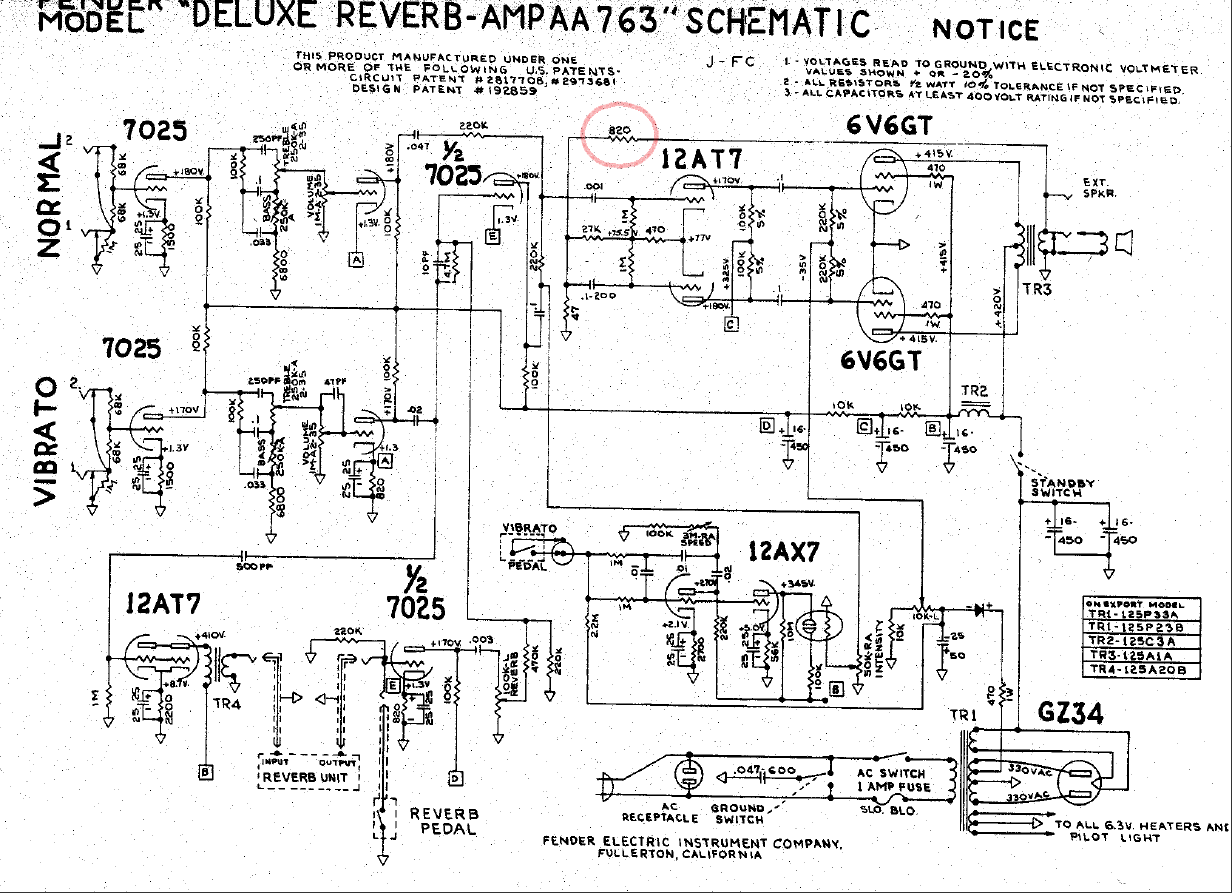
The negative feedback loop can easily be tweaked to alter the treble cut and distortion in your amp. The purpose of the NBF loop is to clean up the tone and cancel out the mid/higher frequencies and upper harmonics (distortion) at the entry point of the phase inverter which is placed in front of the power tubes. The NBF theory is that you take the signal from the speaker output, let it go through a resistor and mix it in at the entry point of the phase inverter. The speaker signal is out of phase (180 degrees) with the signal at the entry point of the phase inverter and will cancel out equal frequencies. If you disconnect the NBF loop you’ll notice that the volume increases and tone gets much more aggressive. More white noise too. unfortunately, which is why there is a NFB loop. You will find the amp’s sweet spot at a lower volume knob setting without the NFB loop. Not only is there a volume shift, the amp’s clean headroom is reduced slightly. Most importantly the tone gets rougher and rawer with more mids and higher frequencies, aka presence. If you think your tone is too bright or harsh or you’re seeking a mellow and nice clean tone, you probably want to keep the NBF loop. This mod is for those who want more bite and a tone that really cuts through in the mix.
You may choose to implement the mod in several ways and in various combinations with the ground switch or a foot pedal. A foot pedal works like a boost/FAT pedal. If yo’re struggling to find a transparent boost pedal that keeps the natural Fender tone you should try this out. You will still have that beautiful Fender tone, just more and wilder.
- No negative feedback at all. Simply disconnect the feedback loop (a wire) and tape insulate it. You get the most effect of this mod by disconnecting the NFB loop entirely. You may experience that the tone gets harsh, depending on guitar, speakers and EQ settings of course. If so, read more about the cap in the next bullet point.
- Keep the feedback loop and install a .01 µF in series with the NBF resistor. This cap will prevent the lower and mid frequencies to go through the NFB loop. Depending on the cap value treble frequencies will be fed back to the phase inverter which cancels out the treble in the main path. The tone gets less harsh and you still have a noticeable effect. You should experiment with different cap values. Start with 0.01µF.
- Increase the feedback loop resistance value. A good starting point is around 1.5 and 3 KOhm. This reduces the effect of the feedback loop, making the amp break up more when the NFB is engaged. If you make the NBF switchable there will be less volume difference if you use a high resistor value. (Using a .01 µF cap is also recommended to minimize the difference a little bit between NBF on and off).
- Use the ground switch or foot pedal to make the NBF switchable. If you remove the death cap and free up the ground switch by removing existing wires to it (if you’re wondering what the ground switch does, you don’t need it). Then wire the ground switch in series with the NBF resistor. If you’re using a cap in the NBF loop this goes across the switch allowing treble to bypass independent of the switch. When the ground switch has disconnected the NBF loop the higher frequencies are still fed back through the cap. In practice you solder each the two cap legs to at each side of the switch between speaker terminal and NFB resistor.
Where to install foot-pedal or switch? The ground switch is easy available if you disable the power supply wires and death cap. For amps with reverb you could use the reverb footswitch phono plug if you are not using it.
Logical schematics
Layout
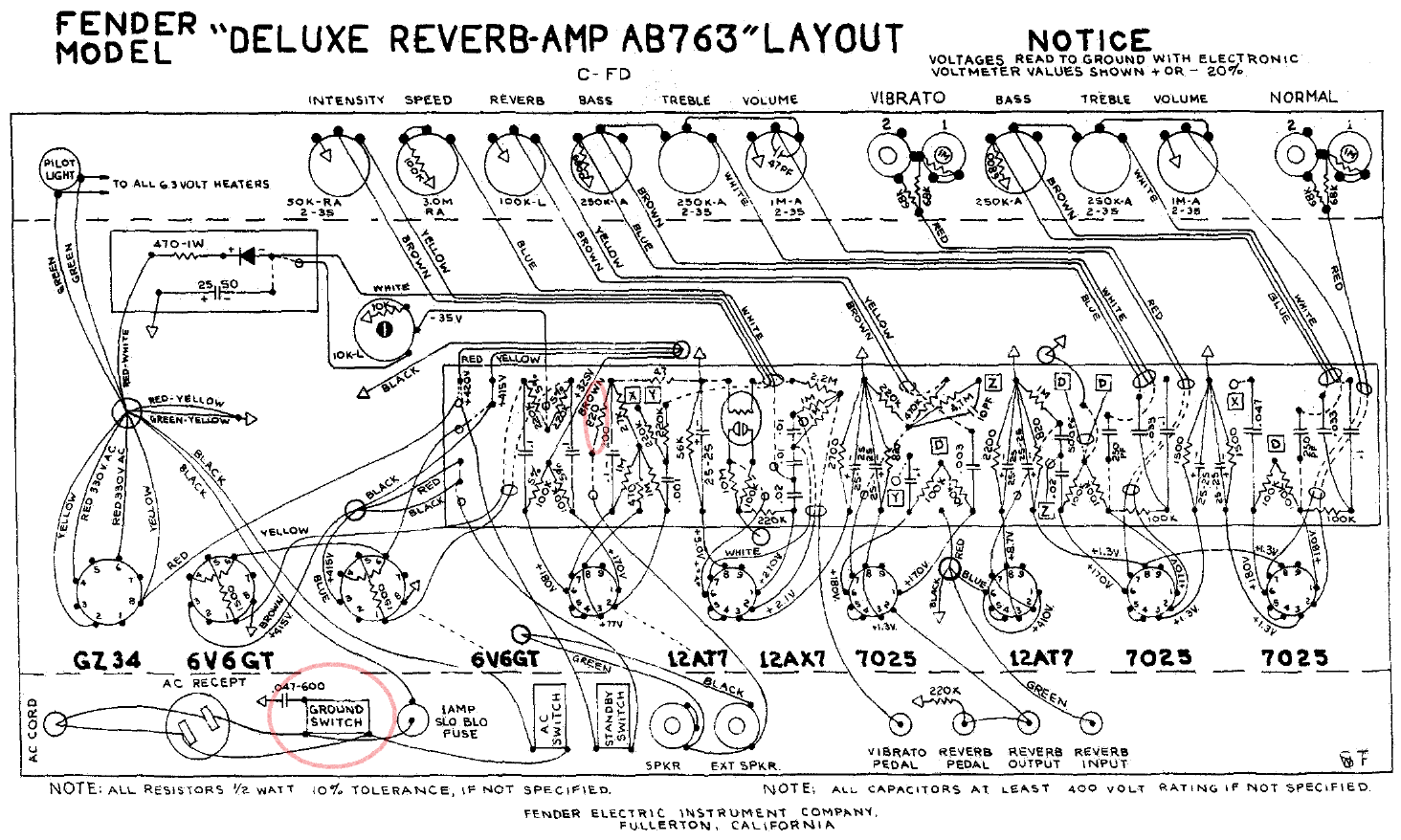
Click images for full size versions.
Middle pot
The Deluxe came unfortunately without a mid pot. Many players are happy with the default 6.8K mid resistor in the EQ circuitry, but some want what the others have; a 10K potmeter mounted in series with the 6.8 Kohm resistor. When the potmeter is set at 0 you’ll have an original tone, and when turned up the mids increases and your amp growls with a British Vox’ish tone (especially together with a Celestion speaker). For a wider tone range you can replace the 6.8 KOhm resistor with a 4 KOhm, and use the 10 K pot to go beyond the original 6.8 KOhm and up to 14 KOhm. If you do not use the reverb or tremolo pedal it is very practical to install the middle pot here. It requires a simple solder and removal job to replace the phono plugs with a mid pot. Or you could install the mid pot at the left most side of back of the amp where the additional power supply is located.
Logical schematics
Layout